
Steps you need to take after getting a new mountain bike
Purchasing any new bicycle is indeed the beginning of a happy life, but only if the bike functions correctly. How should you prepare your bike after the purchase?
When buying a bicycle in-person at a store, trained staff will adjust the components according to your needs. But what if you order a bicycle from an e-shop, or if you are buying one as a gift? Or perhaps you want to broaden your horizons? In this article, we will explain the basic adjustments on a bike so that it functions correctly.
Tire pressure
Tire pressure is the most important adjustment on a bicycle. Even if the entire bike functions correctly, but you have incorrect tire pressure while riding in mountain terrain, it will negatively affect the overall performance of the bicycle.If you buy a bike, it will probably have inner tubes in its tires. The exception are bikes that are rarely equipped with a tubeless system directly from the factory.
Tire pressure is important mainly due to these three aspects:
- Traction – transfer of power to the tire (effective acceleration)
- Comfort – absorption of small bumps
- Grip – how the tire holds in terrain, for example, in a turn
Tire pressure is given in bars and PSI. Pressure expressed in PSI has a finer scale, and therefore is mainly used for air shocks and forks. FYI - 1 bar is 14.5038 PSI.

What if the tire pressure is too high?
Simply put, the tire will feel very hard and will bounce when riding over bumps. We can compare it to an inflated ball bouncing off the ground. Under high pressure, the tire cannot deform well and thus adapt its shape to the unevenness it passes over.We can conclude that the tire will have worse grip. High pressure can also be dangerous, which is why rim and tire manufacturers specify their maximum pressure that must not be exceeded.
What if the tire pressure is too low?
If the tire is too soft, it will deform excessively, especially during more aggressive riding. During simple riding on flat terrain, you might feel good grip, but faster riding on a more technical section will mean that the tire's tracking will be unstable and it might even come off the rim.Worst-case scenario, you could fall and injure yourself; best-case scenario, you will damage your rim. When riding on an under-inflated tire, there is a higher probability of a puncture or a pinch flat (for example, hitting a rock).

So how should I inflate my tire?
Universal charts do not exist. However, it is generally recommended to start with a higher pressure (for example, 2 bar) and gradually, depending on the circumstances, rider's weight, tire width, and riding style, you can reduce the pressure (or increase it if necessary).If you feel that the tire is a bit "jumpy", meaning it bounces off rough terrain, gently release some air. If it's the other way round and the tire deforms too much and doesn't hold its shape while riding, or you actually hit a root or a rock with your rim, inflate the tire more.
To calculate the correct pressure, I recommend this calculator. It may not give you an exact figure, but at least you'll have a starting point. Usually, the front wheel has slightly lower pressure than the rear wheel, as it dictates the line.

SAG
If you have bought a bike with air suspension, meaning with a fork and possibly also a rear shock, you should correctly adjust the pressure in these components. SAG is fundamental.SAG is the compression of the fork or shock under the rider's weight (fully equipped, i.e., with all the gear they ride with). Before the procedure itself, prepare and dress as if you were going for a regular ride in the woods. Take a pump specifically designed for shocks and forks, or borrow one if necessary. Under no circumstances should you inflate the suspension with a regular pump or compressor.

In this case, we will describe the procedure in a few steps.
- Find the O-ring (rubber band) that is on the shock shaft or on the stanchions of the fork.
- Push it as close as possible to the seal.
- Stand on the bike in your basic riding position, fully equipped, of course.
- The suspension will compress. By how much? The aforementioned O-ring will show you.
- Carefully dismount the bicycle so that you don't push the O-ring further, otherwise you would have to repeat this measurement.

TIP: It's easier to adjust SAG gradually. If you have a full-suspension bike, first on the shock and then on the fork (or vice versa).
What SAG should you have? We measure SAG in %. With components from the manufacturer RockShox, we have an advantage, as there is a scale on the shock shaft and the fork stanchions. However, if you don't find a scale, measure the shock shaft or fork stanchions and then calculate the percentage of the compressed fork/shock.
Manufacturer-specified values
The manufacturer often provides values (pressure in PSI) that you should inflate to for your weight. These figures simplify the entire SAG adjustment procedure, but I still recommend checking the SAG even after inflating the fork/shock to the manufacturer's specified values. Manufacturer-specified charts can usually be found on the left fork leg, or on the manufacturer's website.
Most important – what percentage of SAG is ideal?
If there is too much SAG, it means you will bottom out more often. Too little, and you might not be using the full potential of the suspension.The ideal SAG is generally in the range of 20-30 %, again depending on the riding style and the type of bicycle. Some riders prefer a slightly lower SAG on the fork than on the shock.

Handlebar ergonomics
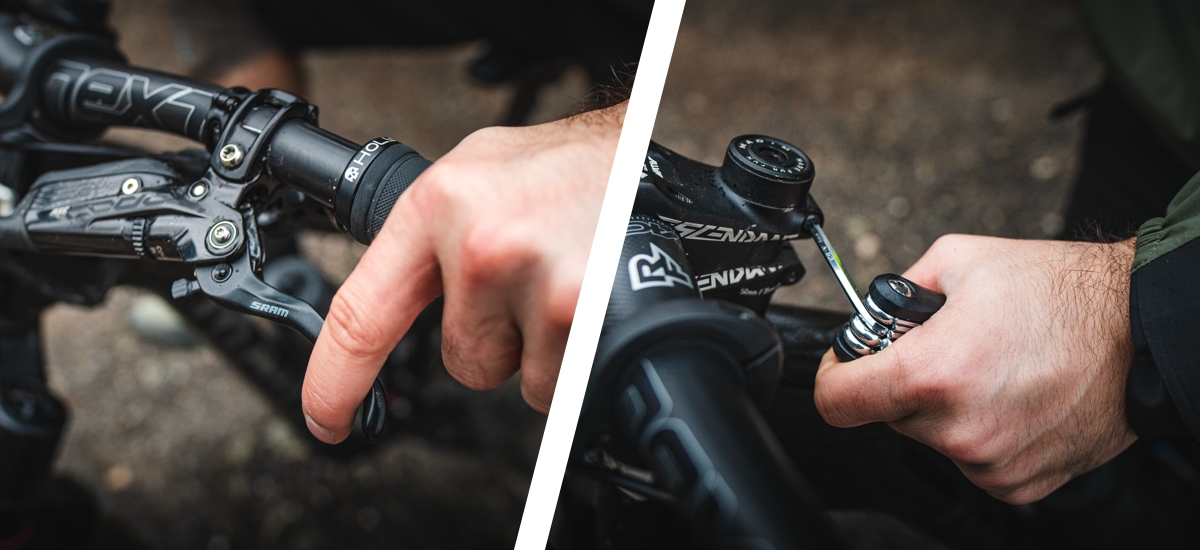
This will certainly be an easier section to read, but when adjusting the levers on the handlebars, be as responsible as you are with tire pressures or SAG.In this case, we will again divide it into several parts, namely:
- Lever placement on the handlebars
- Lever angle (especially brake levers, as we use them most often)
- Handlebar height

Lever placement - what is it essentially about?
On the handlebars, we have brake levers, gear shift levers, a dropper post lever, and possibly suspension lockout levers. While riding, you don't want to deal with not being able to reach the gear shift lever or not being able to lower your dropper post on a descent because its lever is too far from the grip.Therefore, I recommend that you set everything up so that you can operate every single lever on the handlebars while naturally holding the grips. It might take you longer at first, but patience will pay off in this case.

Lever angle
Regarding brake levers, the angle is also very important. If your brake levers are too low or too high, your wrists might hurt. Therefore, try to ensure that your extended finger on the brake lever is in line with your forearm, so that your wrist doesn't bend due to a high or low brake lever.
Handlebar height (stack)
You can raise or lower your handlebars using spacers on the stem. The higher they are, the more the rider's position feels pushed back, and conversely, the lower they are, the more the rider feels positioned forward, i.e., over the handlebars.In this case, I recommend making subtle changes that you need to get used to. It's perfectly fine to change just one spacer, as even that will be noticeable during riding. Lower handlebars can provide a more aggressive or sporty riding position, while higher handlebars are generally about comfort.
The angle of the handlebars is also related to their height, and it might not be adjusted correctly on a new bike. That's why there's a mark on the front of the handlebars, which you can use to easily adjust the angle. I recommend sticking to the mark and not deviating too much from it, as an extreme handlebar angle can cause discomfort and even pain during rides (often wrist pain).

Saddle adjustment - saddle height, fore-aft position, saddle angle
Saddle height adjustment
The easiest way to adjust your saddle height is to sit on the bicycle and try pedalling with your heels. In this case, your legs should be almost straight, but your knees should not be fully locked out. At the same time, your pelvis should not rock from side to side. There are various other adjustment methods that are more precise but more complicated.Fore-aft position adjustment
To adjust the fore-aft position of the saddle, we will use a plumb bob (plumb line). As a first step, set the cranks to a horizontal position. Both feet should be on the pedals. Then, bring the plumb bob (string) to your knee, and the weight should intersect the pedal axle. If the weight does not intersect the pedal axle, move the saddle and repeat the measurement.
Saddle angle adjustment
To adjust the saddle angle, I recommend using a spirit level, or its alternative in the form of a smartphone app. The saddle should be approximately level. If the nose points down, weight is shifted to your hands, causing discomfort. If the nose points up, you might feel pressure on sensitive areas.Every body is different, and therefore it is important to adjust all components according to personal preferences. What suits one person may not suit another.
However, riding position is very important, especially in performance-oriented mountain biking disciplines, which is why we recommend bike fitting for its most precise adjustment.
A correctly set up bike is fundamental
A correctly set up bicycle means comfort, enjoyment of the ride, and happy kilometers on the bike. The difference between a correctly and incorrectly set up bike can determine whether cycling becomes a lifelong hobby or a few-hour episode of suffering.Photo source: editorial archive
Similar articles
 PR article
There are bike components that are easily replaceable, don't have to cost a fortune, and yet have a huge impact on your ride.
Helmets save lives, there's no doubt about that. But how do you choose a helmet, what types of MTB helmets are there, and what should you focus on when making your selection?

Basic bike maintenance tips that will help you avoid complications. Your bike will thank you with smooth operation, and you'll ultimately save money.

 arrow_outward
