

Heart Rate Zones and Their Importance in Training
Riding according to heart rate zones is the first small step into the world of cycling training. But what do the individual zones actually mean?
Cycling is rightly considered one of the best sports for weight loss, your heart rate can really soar on the bike. Nowadays, there is a huge variety of cycling computers that support heart rate monitor connectivity. Some people view heart rate purely as a statistic, while for others, it is a valuable tool for continuous improvement.We won't delve into structured training, but we will introduce the individual heart rate zones and explain their effects on the body.


Your Gateway to Heart Rate Zones
Everyone's heart rate zones are set up differently. However, the common denominator is maximum heart rate. This value changes with age and is inversely proportional to it, meaning it decreases as you get older. You can calculate it in several ways, but perhaps the best-known formula is:220 minus your age.
There are also more sophisticated formulas if you're looking for greater accuracy—but for those, I'll refer you to Google. 🙂 Most modern cycling computers allow you to enter your maximum heart rate into the device or app, and they will automatically calculate your individual heart rate zones. Then you're ready to ride!

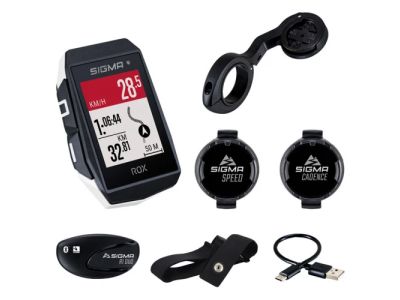
-28% SIGMA ROX 11.1 EVO GPS cycle computer + sensor set, white
179 €
-28%
RRP 249 €

Zone 1 – Your Best Friend at the Start of the Season
If you're not among the small percentage of cyclists who refuse to part with their bike even during winter and instead prefer to use the colder months for rest (or, like me, for indulging in Christmas cookies 🙂), then your spring strategy is fairly straightforward.Most of us would probably love to jump on the bike and take off like a cork from a bottle, but Zone 1 plays an important role when logging those first kilometres.
Also known as active recovery, this zone includes the easiest rides—chatting with friends, spinning your legs, or recovering between intervals.
Rides in this zone have only a minimal impact on muscle development. More importantly, however, the body adapts to aerobic metabolism, meaning it uses fat as its primary fuel source. See? We're back to Christmas cookies. 🙂 Jokes aside, this adaptation is very important for future training and riding at higher heart rates.
- active recovery
- 50–60% of maximum heart rate
- body adaptation to aerobic metabolism (fat burning)

Zone 2 – Ideal for Long Rides
As a long-distance rider myself, this is my favourite zone. Riding at this intensity can be sustained for hours without excessive lactate accumulation. This is closely linked to the adaptation mentioned above—muscles primarily use fat as fuel rather than carbohydrates, from which lactate is later produced.So, if your goal is weight loss, for example, you should focus mainly on Zones 1 and 2. At the same time, Zone 2 builds endurance and makes longer rides more achievable.
- endurance development
- 60–70% of maximum heart rate
- ideal for long rides (fatigue sets in later)
- ideal for weight loss (fat is the primary fuel source for muscle cells)
- increase in the number of mitochondria within cells

Zone 3 – Things Are Getting Serious
Zone 3 is a tempo zone, often referred to as the "sweet spot." However, spending too much time here is generally not considered productive from a training perspective, and it is usually better balanced with time spent in other zones.In essence, it is a kind of "no man's land" between the benefits of Zone 2 (fat burning and aerobic adaptation) and Zones 4 and 5 (which have a stronger impact on muscular and cardiovascular development).
So, is there any point in riding in Zone 3 at all? That remains open to debate.
While it does improve muscular endurance to some degree, other zones generally offer greater training benefits. It's no coincidence that the transition between Zones 3 and 4 is often called the "grey zone." It may feel as though we're working hard and maintaining a solid pace at a high heart rate, but in reality, the body may not be progressing as effectively as it could.
- tempo or sweet spot
- 70–80% of maximum heart rate
- every coach's nightmare 🙂

Zone 4 – The Body Starts to Rebel
In Zone 4, we reach an intensity that few people find comfortable. At first, most riders can sustain it for only a few minutes.Riding in this zone causes lactate to accumulate relatively quickly and places significant strain on breathing. However, the purpose of this training is to improve the body's ability to transport lactate away from the muscles and break it down efficiently.
At the same time, it stimulates mitochondrial development, strengthens the cardiovascular system, and improves resilience during long rides at moderately high intensity. So, if you're training for a marathon, this is where the hard work begins.
- anaerobic threshold
- 80–90% of maximum heart rate

Zone 5 – The Toughest Part of Training?
Zone 5 is also known as VO2 max. This refers to the point at which the body takes in and utilises oxygen at its maximum rate. More precisely, it is the volume of oxygen, measured in millilitres, consumed per kilogram of body weight per minute. Spoiler alert: this is probably not a zone you want to reach on a full stomach. 🙂Zones 2 and 5 sit at opposite ends of the spectrum, yet they often provide the greatest training benefits. This is where the concept of polarised training comes into play, which simply means alternating between these two zones.
But without straying too far from the topic, what is the biggest benefit of those few minutes of suffering? First and foremost, as the name suggests, it is about improving oxygen utilisation, as the heart pumps more blood through the body.
Other benefits include reduced production of harmful metabolic byproducts, a greater ability to sustain moderate to high intensity, and, last but not least, faster recovery.
- VO2 max
- 90–100% of maximum heart rate

Beyond Zone 5 lies the legendary Zone 6—anaerobic capacity. However, I won't cover it in detail, as few cyclists who are just beginning structured training will ever reach it.
In short, the body can no longer process oxygen quickly enough, so energy production shifts primarily to anaerobic metabolism.
We won't get into a specific training plan—that would make this article twice as long. 🙂 In principle, however, you should follow these guidelines:
- ride in Z1 at the start of the season
- spend most rides throughout the year in Z1 or Z2
- try to avoid the transition between Z3 and Z4 (the grey zone)
- include intervals in Z4 and Z5, alternating them with Z1 and Z2

That said, everyone has different goals in cycling. For some, it's enough to lose weight; others simply want to feel fit; and for some, completing a marathon is the ultimate motivation. Your training should always reflect those goals.
Photo source: editorial archive
Similar articles

Ever wondered just how slower a mountain bike is on asphalt climbs compared to a road bike? We tested and compared them, including the ride feel.

Does carbon offer unrivalled properties? Is aluminium merely a low-cost option? In this article, we’ll examine the frame materials used in both road and mountain bikes.

Shopping for a bike? We'll help you decide whether buying new or used offers better value.


 arrow_outward
