
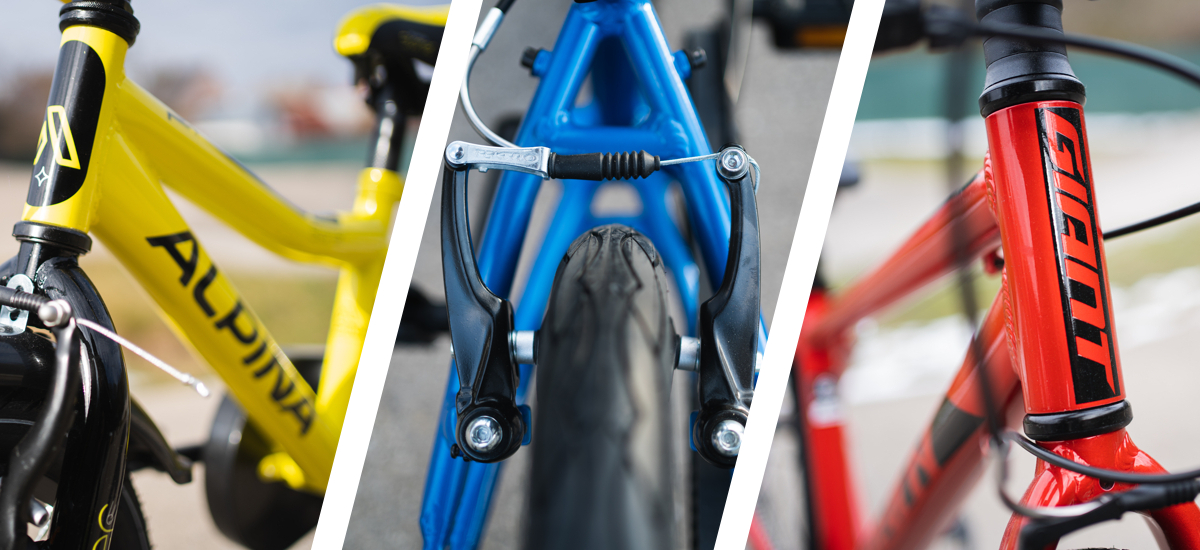
How to Choose a Bike for a Child
Are you wondering what type of bike to choose for your child and what to focus on during the selection process? We’ll try to help and guide you.
Choosing a children’s bike is exciting, but it can also bring a bit of uncertainty. After all, everything is a little different when it comes to children. We want the bike to be neither too big nor too small after a short time. We also don’t know for sure whether they’ll enjoy riding at all.Moreover, today’s selection is virtually limitless. On one hand, this makes it possible to find the perfect fit; on the other, it can make the decision more difficult if you’re unfamiliar with the options or unsure which features matter most. This article will help you with the basics.
Key links:
- children's bikes and balance bikes in our MTBIKER e-shop,
- children's helmets, protectors, gloves, and other accessories for safe riding,
- lights and bells.
💡 Tip: The most important parameter is not the child’s height, but their inseam length. While overall height provides a useful indication, the distance from the crotch to the ground (the inseam) determines whether the child can safely reach the ground and whether the frame geometry allows for a natural riding position. When choosing sportier models, low weight is also an important consideration—an ideal children’s bike should weigh no more than 35–40% of the child’s body weight.
We’ll explain everything in more detail below.
The right size is key
Let’s start with the basics. The most important aspect of choosing a children’s bike is selecting the correct size. More specifically, the wheel size rather than the frame size, as the wheels form the primary starting point.Of course, there is always some overlap between size ranges. If you look closely, the recommended values often intersect. We’ll come back to that later; for now, the chart serves as a useful starting point to help narrow down your options.

Age ranges are only approximate, as every child develops differently. Therefore, it’s important to consider both overall height and inseam length (the distance from the crotch to the ground).
The child should wear their shoes during measurement. Then, place a sturdy, straight object—such as a book—against a wall on top of their head. This will help determine whether the child can comfortably reach the ground while sitting on the bike, which is especially important for younger riders.
Once you’ve narrowed down your options, the best approach is to let the child try the bike. Simply put, they need to feel comfortable and safe on it.
A good indication of the correct size is that, when standing over the bike, there is enough space to fit a fist between the top tube and the child’s crotch. If you’re buying online, measure the child carefully and aim for the middle of the recommended size range. This is exactly why the recommended sizes overlap—you avoid ending up right on the boundary between two sizes (see the chart above).


What about a slightly larger bike?
You might be thinking that buying a slightly larger bike would allow your child to grow into it. In the past, this was a common approach, mainly because there were fewer options available. However, this strategy carries a risk—the child may not enjoy riding the bike at all.If the bike is too large, it will be difficult to control, significantly reducing riding safety. It’s therefore best to choose a bike that fits properly. The good news is that children’s bikes are easy to resell nowadays, for example through our MTBIKER marketplace. They usually sell very quickly.
12-inch wheels and balance bikes
Let’s begin with the youngest riders. At this stage, there are two options: a balance bike or the smallest pedal bike. If the child cannot reach the pedals or you feel they are not yet ready for cycling, a balance bike is the ideal solution. For many children, a balance bike is the perfect first “bike.” They can often start using one before the age of two.Kids appreciate how easy to use and manoeuvrable they are.
Naturally, the child must be able to reach the ground comfortably. Most modern balance bikes feature adjustable saddle and handlebar heights, allowing them to be used for a relatively long period until the child gains confidence or decides to move on to a pedal bike.
Balance bikes are generally similar. Most have 12-inch wheels, although even smaller models are available. They vary mainly in price, with more expensive versions often offering additional features. These may include lightweight aluminium frames, wider tyres, footrests, or even brakes.


While a brake is not essential, since children primarily stop with their feet, it can help them develop proper braking habits. Modern balance bikes such as the Kiru Race can also handle light off-road terrain thanks to their wider tyres, making an additional brake useful.
With 12-inch pedal bikes, removable training wheels are common. These can be removed entirely or adjusted to change the level of support. These bikes are typically single-speed and often feature a coaster brake, which is activated by pedalling backwards.

Children particularly appreciate their ease of use and excellent manoeuvrability. These bikes are equipped with chain guards to prevent contact with the chain and handlebar end protectors that help protect hands in the event of a fall. They also reduce the risk of the handlebars slipping from the child’s grip.


Both saddle and handlebar height are often adjustable, allowing the bike to adapt to a child’s rapid growth.

14-inch bikes
If your child is slightly older or has mastered a balance bike with ease, a 14-inch model may be the ideal first pedal bike. These bikes share many of the same features and construction elements as 12-inch models, although they are often sold without training wheels.Another difference is that many bikes in this size category no longer rely solely on coaster brakes and may instead feature a freewheel and two independent hand brakes, similar to adult bikes.


16-inch bikes
Very often, a 16-inch bike becomes a child’s first pedal bike after using a balance bike—especially if they remained comfortable on a balance bike for longer or started cycling at an older age.These bikes are still excellent learning tools, even for older beginners. They are available with training wheels, coaster brakes, or freewheels combined with independent hand brakes. The choice largely depends on whether the child is a complete beginner or already has some riding experience.


20-inch bikes
Low weight is extremely important because it has a major impact on the riding experience.
At this stage, bikes become more specialised, and the range of available models expands considerably. Some are designed for off-road riding and may even include suspension forks. However, if your child is not yet riding demanding terrain, the simplicity and lower weight of a rigid fork are often the better choice.

Gears also become an important consideration. Bikes with derailleurs offer significantly greater versatility and are a good choice for children who want to ride more frequently or tackle varied terrain.
On the other hand, if the bike is mainly for fun and casual riding, a single-speed model remains a perfectly valid choice and is much easier to maintain.
Brakes are another important component. For everyday riding, traditional rim brakes are more than adequate. Children interested in more demanding off-road riding may appreciate the extra stopping power of disc brakes, including hydraulic systems.
The trade-off is slightly higher weight and more involved maintenance.
Low weight is important
At this point, it’s worth emphasising one key factor: low weight has a huge influence on the riding experience. Children are smaller and therefore feel every extra kilogram—not only while riding but also when handling the bike.A 2 kg difference on an adult bike may be barely noticeable, but for a 20 kg child it can be significant. Imagine an 80 kg adult riding a 25 kg bike. That’s roughly how a child feels on a heavy steel bike. For this reason, lightweight aluminium frames are highly desirable.
Components also matter. Heavy steel handlebars or seat posts can add unnecessary weight. Modern children’s bikes increasingly use lightweight aluminium components designed specifically for younger riders.
There is no need to prioritise suspension or hydraulic brakes if the bike is mainly intended for casual riding and fun. Those features can always come later if the child develops a stronger interest in challenging terrain.
24-inch bikes
These bikes are essentially miniature versions of adult bicycles, adapted to suit a child’s size and handling needs.
They represent a transitional stage where intended use becomes increasingly important. Does the child want to ride trails and tackle rough terrain, or simply enjoy riding around the neighbourhood?
If you don’t invest in anything else, a helmet is still an absolute must-have.
Components are now much more purpose-specific. If your child prefers off-road riding, it makes sense to choose a bike designed for that purpose. Since they are larger and stronger at this stage, a little extra weight in exchange for comfort and durability—particularly in the form of suspension or disc brakes—can be worthwhile.
Conversely, children who enjoy faster riding on roads and cycle paths will likely appreciate a lighter bike with sportier geometry, especially on longer rides.
26- and 27.5-inch bikes
If your child has outgrown a 24-inch bike, a 26-inch model is often the next step. What distinguishes these bikes from adult models are the smaller frame sizes available and components adapted for lighter riders, such as suspension forks tuned to lower rider weights.The same selection principles that apply to 24-inch bikes apply here as well.
A separate category consists of 27.5-inch bikes, whose greatest advantage is improved off-road performance. They roll over roots and rocks more easily and provide greater stability on descents.
When should you choose a children’s e-bike?
Just a few years ago, children’s e-bikes were rare. Today, they are a standard part of many manufacturers’ ranges. Some parents worry that they might make children lazy, but practical experience often suggests the opposite. E-bikes can help bridge performance differences and enable families to spend more time riding together.So when does a children’s e-bike make sense? If you are active parents whose rides regularly cover 40 km with around 800 metres of climbing, a child on a conventional bike may struggle to keep up. An e-bike can allow everyone to enjoy the ride without the need for towing.
For children who cannot physically match the pace, cycling can become frustrating. Motor assistance helps them tackle the toughest sections so they return home smiling rather than completely exhausted.
When choosing a children’s e-bike, don’t focus solely on motor power. Consider the following:
- Weight: The biggest drawback. The motor and battery add significant weight, typically bringing the bike to around 15–18 kg. The child must still be able to control it safely.
- Smooth power delivery: Some lower-quality motors engage abruptly. For children, smooth assistance is essential for safe and predictable handling.
- Speed limit: Most children’s e-bikes limit assistance to 20 km/h rather than the standard 25 km/h for safety reasons.
- Battery capacity: Because children are lighter, even a smaller battery (250–400 Wh) can provide excellent range while helping keep weight down.
An e-bike is not a substitute for physical activity. Rather, it is a tool that can expand opportunities and make longer rides accessible. However, if a child has not yet mastered basic riding skills on a conventional bike, motor assistance should not be seen as a substitute for learning proper technique.
Brake lever reach – small hands need special attention
Many parents assume that if a bike is labelled as a children’s model, every component is automatically adapted for children. This is often not the case, particularly with brake levers. Children have smaller hands and less finger strength than adults.Why is reach adjustment so important? If a child must stretch their fingers to reach the brake lever, they lose a secure grip on the handlebars. This increases the risk of losing control over rough terrain or during sudden impacts.
Fingers generate the most force when slightly bent. If the lever is too far away, the child can only brake with their fingertips, which may not provide enough force for an emergency stop.
How should it be adjusted? Most modern children’s bikes feature a small adjustment screw on the inside of the brake lever. Tightening it moves the lever closer to the grip.
The ideal setup: the child should be able to wrap the first joint of their index and middle fingers comfortably around the lever without releasing their grip on the handlebars.
For very small hands, ensure that the lever does not touch the grip before maximum braking force is reached. If it does, cable tension or hydraulic setup may require adjustment.
💡 Our tip: If you’re buying a bike for a very young child, look for models equipped with “Short Reach” brake levers. These are shorter and designed to provide strong braking performance with minimal hand strength. Premium models increasingly feature hydraulic brakes, which are particularly well suited to children because they require very little force to operate.
Accessories that will definitely come in handy
It’s important to remember that buying the bike itself is only the beginning. If you choose just one additional item, make it a helmet. It is the foundation of cycling safety, whether the child rides a balance bike or a full-sized bicycle.Today, there are helmets available for every age group, and there is no better time to establish the habit of wearing one than from the very beginning. It also helps if you wear a helmet yourself and lead by example. 😉
Very useful accessories include lights and reflective elements such as bands, vests, and reflective straps. They are inexpensive but can significantly improve visibility and safety, even during everyday rides around residential areas.
Protective gear such as gloves and pads is also worth considering. Gloves are particularly useful because they help prevent scraped palms, one of the most common injuries in minor falls. With a wide range of sizes and colours available, there is something suitable for every child.
You’ll find a wide selection of models in the MTBIKER shop.
Photo source: editorial archive
Similar articles
The selection is vast, prices vary widely, and the number of cycling glasses available seems endless. How do you make sense of it all and choose the right pair?
Cycling can be an expensive sport. Whether it's components, bikes, or apparel, some items can put a serious dent in your budget. So which purchases are actually worth the investment?
 PR article
Whether on a trip, during a race, or while commuting to work, it's worth having reliable gear within reach.



 arrow_outward
