

































































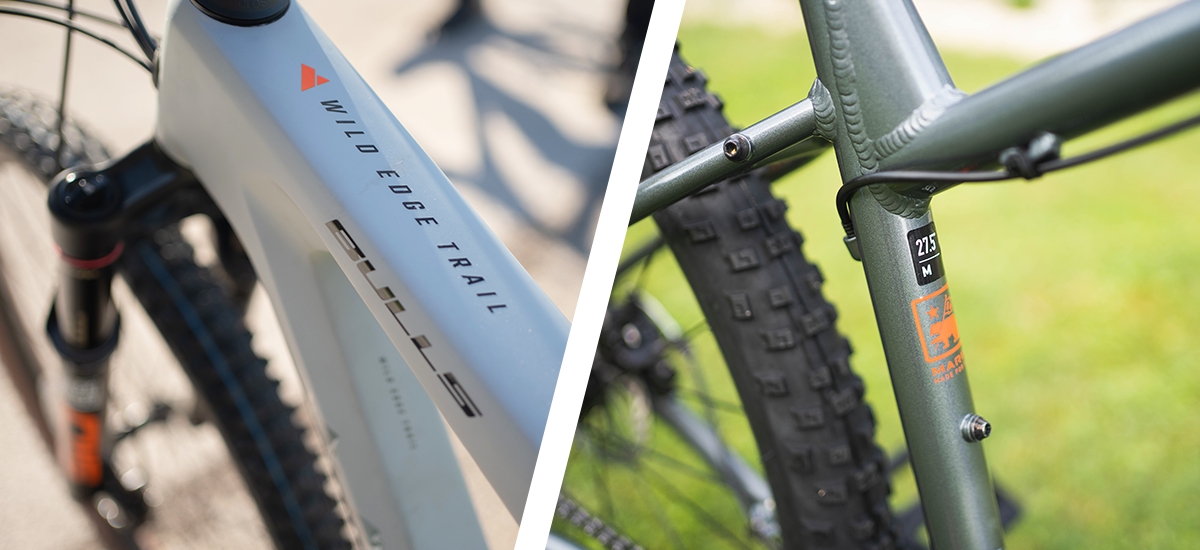
Which frame material is best?
Does carbon offer unrivalled properties? Is aluminium merely a low-cost option? In this article, we’ll examine the frame materials used in both road and mountain bikes.
At first glance, the topic of bike frame materials may seem straightforward, and it’s often surrounded by stereotypes. Aluminium is cheap but heavy, while carbon is expensive and light. Only connoisseurs ride titanium, and steel? It probably disappeared along with classic Favorit bikes. 🙂However, as is often the case, the reality is more complex.
Aluminium vs. Carbon
The two most common materials used for bicycle frames are aluminium and carbon. The former dominates the more affordable bike segment, while the latter reigns in the world of racing and performance.However, not all aluminium is the same, and not all carbon is the same. It’s common to hear that high-quality aluminium can outperform low-end carbon in certain respects.
A prime example is the CAAD (Cannondale Advanced Aluminium Design) series. So, what are the strengths and weaknesses of these two leading contenders?


Aluminium
Aluminium frames are currently the most widespread and are probably the easiest to mass-produce. They are also the most suitable option for riders who are new to road or mountain biking or who have a more limited budget.Aluminium is relatively light, corrosion-resistant, and won’t give you a heart attack at the checkout. It is also quite stiff for its weight.
However, that stiffness also brings some less desirable characteristics. This is particularly noticeable on road bikes. Let’s be honest—road surfaces are often far from perfect, and when I rode an older aluminium road bike, I frequently found myself thinking: “I wish I already had a carbon bike...”
Simply put, because aluminium frames are stiff, they absorb road vibrations less effectively (although, to be fair, even carbon won’t completely solve the problem of rough roads 🙂).
A more significant drawback is that every aluminium frame will eventually develop fatigue-related cracks, and repairs are usually not practical. In road cycling, this is relatively uncommon because frames are subjected to lower stresses.
In demanding disciplines such as enduro or downhill, cracked frames are more common—especially for heavier riders. 🙂
Aluminium Frames: Pros & Cons
- ➕ relatively light,
➕ relatively easy to manufacture,
➕ affordable,
➕ corrosion-resistant,
➕ modern frames can be highly refined, with smoothed welds.
➖ poor vibration absorption, resulting in less comfort,
➖ cracks generally mean the end of the frame, as they cannot be safely repaired.
💡 Did you know…?
Every aluminium alloy has a four-digit designation. The base material is always aluminium, but because pure aluminium is relatively soft, other elements such as magnesium, chromium, copper, and iron are added.
These additives are represented by the first digit of the four-digit code. For example, the widely used 6061 alloy contains primarily magnesium and silicon. The remaining digits identify the specific alloy variant.


Carbon
Every racer's dream? A carbon bike, of course. Surprisingly, carbon’s greatest strength is not its low weight. Carbon frames are both stiff and comfortable. This is where they differ from aluminium, which is generally light and stiff but often less comfortable. To understand why, we need to look more closely at how carbon frames are made.Unlike aluminium, which is shaped using heat, carbon frames are produced in molds. Layers of carbon fibre are placed inside and bonded together with resin to form a composite material.
By varying the orientation and arrangement of these layers, manufacturers can achieve different characteristics:
- Frame stiffness – Carbon frames are often described as stiff. Simplified, when force is applied to the frame, stiffness can be increased by orienting the carbon fibres away from the direction of the load.
- Comfort – Unlike aluminium, carbon can be engineered to flex significantly. A good example is the Ghost Lector. Its curved seatstays, inspired by leaf-spring designs commonly used on trucks and pickups, help improve vibration damping. When flex is desired in a specific area, the fibres are oriented in the direction of the applied force.
And the best part of this phenomenon—known as anisotropy—is that the fibre orientation and the number of layers can be tailored to specific requirements. This allows engineers to maximize stiffness in areas such as the bottom bracket for efficient power transfer while allowing controlled flex elsewhere to improve comfort.
Carbon flex is especially useful in MTB frames with single-pivot linkage designs (zero-pivot or flex-pivot systems), where some of the suspension movement is provided by the seatstays themselves.

The thought of a carbon frame also appeals to many weight-conscious cyclists. In addition, the manufacturing process allows virtually any shape to be created, improving aerodynamics, enhancing compliance, or simply producing a unique design. 🙂
The downside of carbon is its vulnerability to certain types of impact. We occasionally see broken frames, handlebars, or seatposts even in WorldTour races.
Professional racing subjects bikes to far more extreme stresses than typical recreational riding. Unlike aluminium, carbon frames can often be repaired—unless the damage is catastrophic. 🙂
One thing every carbon-bike owner should pay attention to is bolt torque. A torque wrench is a worthwhile investment.
Carbon Frames: Pros & Cons:
- ➕ excellent weight-to-stiffness ratio,
➕ greater riding comfort,
➕ highly adaptable frame shapes,
➕ long material lifespan.
➖ high price,
➖ susceptibility to certain impact-related damage,
➖ difficult to recycle.
💡 Did you know…?
The first commercially successful carbon-framed bicycle was the Kestrel 4000, introduced in 1986. However, the very first carbon bike was the Bowden Spacelander from 1960, whose futuristic design was far ahead of its time.
A carbon bike first appeared at the Tour de France in 1989 in the form of the Look TVT ridden by Greg LeMond.


Steel
My first road bike was, of course, a steel Favorit. It was quite heavy and had impractical shifting, but it was mine. I didn’t ride thousands of kilometres on it before moving on to aluminium. 🙂Steel dominated cycling 40–50 years ago before gradually being replaced by aluminium and carbon. The reasons were simple: weight and cost.
Steel is known primarily for its strength, yet it is also surprisingly flexible. At one point, I considered converting my Favorit to a modern 10-speed groupset, but the rear dropout spacing presented a challenge.
Still, steel’s flexibility meant the rear stays could be adjusted if necessary. While such modifications are hardly ideal, they illustrate the material’s forgiving nature. Longevity, durability, and ease of repair are among steel’s greatest strengths.
That said, steel’s disadvantages are equally clear. Compared to competing materials, steel frames are heavy. Since steel is essentially iron-based, it is also the only common frame material that is susceptible to corrosion.
Even so, steel remains popular for affordable fitness bikes, bikepacking rigs, and trail hardtails, where its durability and comfort are valued. Could we be witnessing a revival of the phrase “steel is real”?
Steel Frames: Pros & Cons
- ➕ strength,
➕ flexibility and improved comfort compared to aluminium,
➕ longevity,
➕ ease of repair.
➖ higher weight,
➖ susceptibility to corrosion.
💡 Did you know…?
In 1978, the one-millionth Favorit bicycle rolled off the production line in Rokycany. By the company’s closure in 2001, more than two million of these legendary bicycles had been produced.

Titanium
A bike for life? Titanium is certainly a strong candidate. It shares many characteristics with steel—it is durable, resistant to damage, and relatively easy to repair, at least compared to aluminium. It also offers excellent corrosion resistance.And yes, after buying a titanium bike, you may not have much money left for food for a while. 🙂
Jokes aside, titanium bikes have earned a reputation as luxury machines. The material is especially popular among boutique frame builders, resulting in many unique creations.
Like aluminium, titanium requires alloying elements such as vanadium and aluminium to achieve optimal properties. The resulting titanium alloys offer a superior strength-to-weight ratio compared to steel, many of the advantages associated with carbon, and exceptional durability. Most titanium frames are backed by lifetime warranties.
So why isn’t titanium widely used in professional racing?
The answer is simple: cost. Producing a high-quality titanium frame is difficult and labour-intensive due to the material’s unique properties and demanding manufacturing requirements.
Welding titanium also requires special care. Because titanium reacts readily with oxygen at high temperatures, argon shielding is used throughout the welding process.
Titanium Frames: Pros & Cons
- ➕ durability,
➕ resistance to damage and corrosion,
➕ excellent strength-to-weight ratio.
➖ high price,
➖complex manufacturing process.

The discussion could continue with more exotic materials such as magnesium, bamboo, or wood. More recently, 3D printing has also gained attention. In our region, the four materials above remain by far the most common.
When choosing a frame material, several important questions should be considered:
- How much am I willing to invest in the bike?
- How long do I plan to keep and ride it?
- What is the rider’s weight?
Answering these questions can provide a clearer picture of which frame material is best suited to a particular cyclist.
Photo source: editorial archive
Similar articles
How do you navigate the vast selection of rims, wheels, and tyres? Will you choose aluminium or carbon, inner tubes, or even tubulars?
Everyone knows Tiagra, Ultegra, and Dura-Ace. But where do the names Shimano gives to its road groupsets come from?
Shopping for a bike? We'll help you decide whether buying new or used offers better value.
Product selection


New model Giant Defy Advanced 2 bike, abyss black/chrome, display piece
2,599 €
RRP 2,699 €


 arrow_outward
