

































































Running 101: Are You Breathing Correctly?
How does breathing affect your body during a run, and how can you make your breathing as efficient as possible?
When running, many runners track a variety of metrics such as pace, heart rate, lactate, stride length, and more. However, we pay less attention to how we breathe.During physical exertion, the body needs more oxygen and must expel carbon dioxide. And this is one of the essential aspects that are often neglected by runners.
Proper breathing is crucial during running because it affects the entire functioning of the organism. Thanks to correct breathing, we can better manage the running load, reduce the feeling of breathlessness, and maintain a natural rhythm of movement.
During running and any sports activity where the body is put under stress, the demand for oxygen consumption increases. For this reason, it is essential to know how to breathe correctly. Indeed, I often see runners restricting their own breathing, whether through a tense body posture or by forcibly pulling in the stomach.

Why learn to breathe correctly?
If you want to improve your running, it makes sense to improve your breathing too. You must be aware of it during your run and train it at the same time. This means that breathing must be conscious.Whether you are a beginner or an advanced runner, proper breathing practice is equally important for both. Just as you train hard intervals or running technique, you also need to make your breathing more efficient.
Symptoms of incorrect breathing technique
- fast and shallow breaths
- excessive breathlessness
- feeling of a lack of air
- side stitch (pain in the side)
- dizziness
Benefits of proper breathing during running
- better management of the running load
- more comfortable and natural breathing
- heart rate can be reduced
- better core stability
- faster recovery after exertion
- reduced feeling of breathlessness

Breathing through the nose or mouth?
This is a fundamental and frequently asked question from runners. Generally speaking, breathing through the nose or mouth depends on the intensity at which you run.Nose breathing is effective because the air is humidified and filtered in the nose, reaching the lungs clean and warmed up. This helps especially in colder weather. The airways are thus less susceptible to the cold, and filtering the air is particularly helpful when running in cities with polluted air.
However, it may happen that inhaling through the nose is simply not enough for you. Therefore, you should use it mainly during low-intensity runs.
For beginners, however, nose breathing can be a challenge even during a very slow run. That is why I recommend starting by inhaling not only through the nose but also slightly through the mouth. The inhale must be deep and smooth, not choppy and irregular.
Over time, the body can adapt more and more to nose breathing, your fitness will increase, and you will naturally stop involving your mouth in breathing at low intensities.

Your breathing style depends precisely on the intensity of the run. The faster the run, the faster the breathing. The slower the run, the calmer the breathing. So, if you are doing a recovery run, try to choose nose breathing. When you are doing an intense workout or racing, breathing through your mouth as well is more appropriate. This way, you get a larger amount of oxygen into your body.
However, in neither case should the breathing be shallow. It is always important to breathe fully, which will ensure a better rhythm and more efficient breathing with a sufficient amount of air.
Do not restrict your own breathing
Breathing is a natural process, so do not try to create unnecessary muscle tension. Do not tense your lips or jaw, and do not raise your shoulders, so as not to disrupt your natural breathing rhythm. Keep your shoulders and jaw relaxed and breathe smoothly. Do not try to hold your breath, nor unnaturally prolong the inhale and exhale.How to do it in practice?
Breathing needs constant attention. During every run, try to really tune into your own breathing.When you start running, the body feels good at first, but after a few minutes, you may experience a greater lack of air and breathlessness. Therefore, breathe properly right from the very first step to keep your body sufficiently oxygenated. Running technique, specifically the position and movement of the arms and torso, also plays an important role in proper breathing.

Try to keep your arms at the sides of your torso and do not swing them across your body. For example, if you cross your arms, your chest will be more compressed, which can restrict your breathing.
At the same time, relax your shoulders and do not pull them upwards. Stand tall and keep your head straight in line with your spine. Incorrect head position can also restrict airflow.

 ksulka

 cepooo
Both beginners and experienced runners can be surprised by a side stitch during a run. Surely many of you have experienced that feeling when, during a run or a race, a pain so sharp comes on that you have to stop.
If you want to prevent this and at the same time utilise your full lung capacity, a good way to improve your breathing is to improve diaphragmatic (belly) breathing. This helps to get the inhaled air lower into the lungs, where it stays longer. Diaphragmatic breathing also reduces the likelihood of getting a side stitch because the diaphragm works better.
What can contribute to a side stitch?
- Fast pace from the start: If you start running and set a high pace right from the beginning, a side stitch can come on relatively quickly.
- Too full a stomach: Running with a full stomach does not benefit breathing. A full stomach presses on the diaphragm, which can cause a side stitch.
- Poor posture while running: We have already mentioned the position of the arms during running. The body works as a whole, so excessive arching of the back can also be a risk.
- Shallow breathing: It is shallow breathing and an insufficient amount of oxygen that can also contribute to a side stitch. Therefore, it is important to breathe deeply.
- Weak core muscles: Running also involves exercising and strengthening the upper body. The firmer and stronger it is, the more stable and upright you will be, and your breathing will also improve.


The rhythm of proper breathing
When running, we want to achieve the best possible coordination of the entire body. This is how movement can become economical and more efficient. Your legs and arms work correctly, you have the right body posture, and you must coordinate your breathing with this. In other words, you coordinate your running with your breath based on your pace.Rhythmic breathing means coordinating the ratio of inhales and exhales with your steps. However, this is just a guide, and you do not have to force a specific ratio. During a slow run, it can be an inhale-to-exhale ratio of 3:3 or 4:4. So, you take an inhale over 4 steps and an exhale also over 4 steps. If you cannot catch your breath, you can shorten it to 3:3, and during a fast run to 2:2.

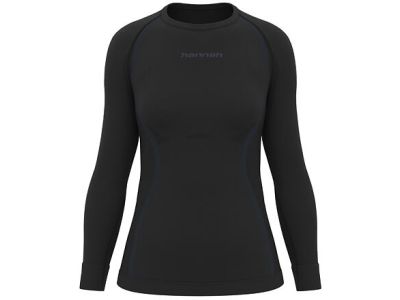
New model -7% Hannah Thermo Active TS women's long-sleeve shirt, anthracite
53.99 €
-7%
RRP 57.99 €

Different people prefer different ratios, and what works for others may not work for you. The important thing is to find your most suitable rhythm and coordinate it with your steps. Yes, at first it may seem unnatural and difficult. Over time, however, it will become natural and can help you increase performance and feel better.
Breathing rhythm can be a helpful tool, but it should not restrict you. If you feel a lack of air, you do not have to force yourself to stick to one of these rhythms; instead, let your body breathe freely, as it needs.
Train your breathing during easy runs
When is the ideal time to train your breathing? It is recommended to focus on your breath mainly during easy runs. That is when you have the time to concentrate on it more than during intense training.
Practising proper breathing at rest
Practising proper breathing is a way to become more aware of it. Lie on your back, keeping your body nicely relaxed and straight. Your shoulder blades are resting on the ground, knees are bent, and feet are flat on the floor. Place one hand on your chest and the other on your abdomen.In this position, start breathing only into your abdomen so that only that hand rises. Repeat this several times. Then switch it up and breathe only into your chest, ensuring the hand on your abdomen does not rise at all. Repeat this several times as well.
Finally, combine both: first, inhale so that the hand on your abdomen rises, and then continue into your chest. On the exhale, let both your abdomen and chest sink naturally.
In this way, you can train your breathing and perceive the correct movement of the abdominal cavity and chest. More air equals more oxygen, better muscle oxygenation, better performance, and a better feeling when running. The important thing is that you feel as good as possible while running and can enjoy it.
In the colder months, the weather can be changeable. To stay comfortable and enjoy running in any weather, you can add to your kit if you are missing anything. In our range on the MTBIKER e-shop, you will find plenty of high-quality clothing to bring joy to your runs.





-17% adidas ULTRABOOST 5 women's shoes, core black/core black/core black
149 €
-17%
RRP 179 €


 arrow_outward
