

































































Garmin Cirqa: A screenless fitness tracker that surprises
A few months ago, I decided to make a change. After wearing the Whoop 5.0 for a year, I gave Garmin's brand-new model, the Cirqa, a chance.
As an active cyclist, I was curious to see how Garmin's sensor would handle something that had been bothering me about Whoop for a long time: the accuracy of heart rate measurement during exercise.But let's start from the beginning. What exactly are screenless trackers – i.e. fitness bands without a display – and why should you care about them?
The concept is simple: you wear a band 24/7 that collects all your data (heart rate, HRV, sleep, movement), but it doesn't display this information directly on your wrist. Everything is available in the app on your phone.
The advantage? No distractions, no battery drain from a display, and longer battery life compared to a sports watch.
On a bike computer, you can see your heart rate in real time much better than on a small wrist display, but after your workout, you'll check the complete stats in the app anyway. The first product to popularise this category was Whoop. Now, it has a challenger – and a serious one at that.

First impression: less is more
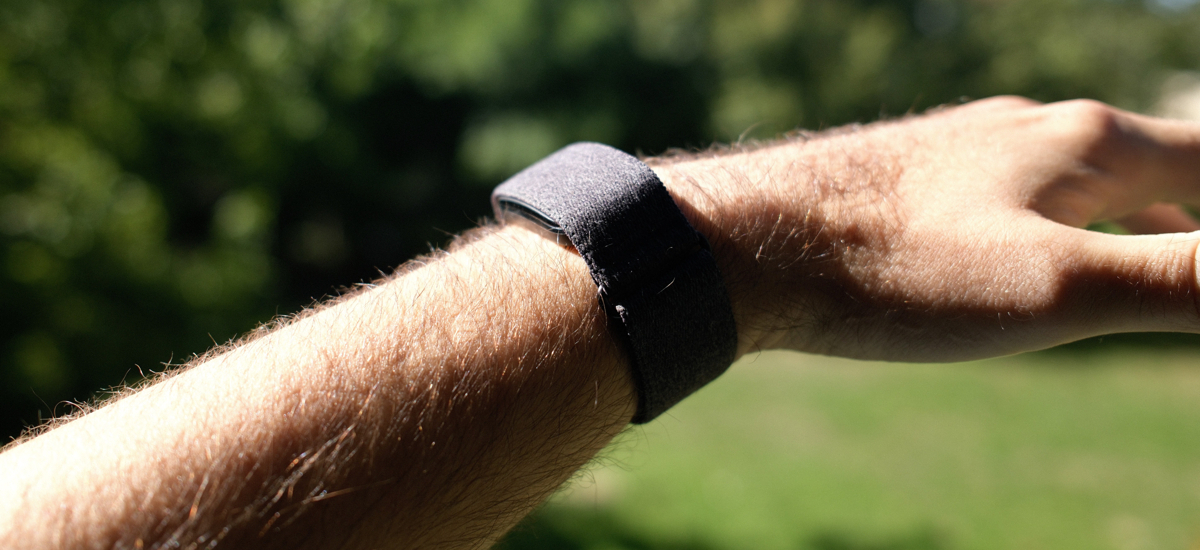
When I first got my hands on the Cirqa, I was surprised that it looks truly minimalist. Not cheap, but subtle and elegant. No display, no array of side buttons, just a slim band with a single physical button on the side and an optical sensor on the underside.That single button has a specific purpose: starting an activity. And it can be configured in the app – you just set up exactly what the button does. Personally, I find this to be a great solution in an era where we're bombarded with hundreds of notifications every day and spend too much time staring at screens.
A band without a display = fewer distractions.
The band is comfortable to wear – it dries quickly, breathes well, and doesn't cause chafing even after a long ride. And mind you, this band is exactly what comes in the base version.
Whoop offers their SuperKnit material for an extra charge – with the Cirqa, it's included. The selection of strap designs and colours is not the richest yet, but Garmin has promised to expand the range.

Tracking – accuracy that matters
This brings us to the heart of the matter – and my main grievance with Whoop. During longer bike rides (I'm talking 3–4 hours in the saddle), the HR from my Whoop would start to drift from what my bike computer with a chest strap was showing. Not dramatically, but enough to make me doubt the data. I suspect this might have been caused by vibrations and bumps from the bike.So far, I haven't had this issue with the Cirqa. The optical sensor is excellently calibrated – even during hard workouts (bike rides, intervals, running), the data matches up. For a cyclist, as well as a runner, this is crucial.
The Cirqa measures heart rate (HR), heart rate variability (HRV), oxygen saturation (SpO₂), physical strain and stress, sleep stages, Body Battery, and Training Readiness.
Of course, an optical wrist sensor will never be as accurate as a chest strap – that goes for every tracker on the market.
Garmin also offers an extended bicep strap for the Cirqa, which is worn on the upper arm – the tracking is more accurate there. For my daily tracking of trends, strain, and recovery, the wristband is more than enough.


Garmin Connect: a bit of a learning curve, but worth it
Most people know Garmin Connect as the app for the entire Garmin ecosystem – Fenix, Forerunner, Edge, and so on. It is packed with features. When you switch to Garmin Connect from Whoop, where the app interface is minimalist and focused on just a few key metrics, you might feel a bit lost at first. But after a few days, I got used to it.There is a ton of app customisation, allowing you to tweak the home screen and features. Over time, I've come to appreciate the depth of what Garmin offers. I can set up what the app displays and in what order, see several weeks of context in a single overview, and work with metrics such as Training Status, Training Readiness, or detailed HRV graphs, which Whoop displays in a simpler way.

One feature that will particularly please cyclists: ANT+ broadcast HR. The Cirqa can broadcast your live heart rate directly to your bike computer (Garmin Edge, but also other compatible devices). No chest strap, no hassle – heart rate straight from your wrist to your bike computer while riding. This is highly practical in real-world use.
I can start an activity from the app or directly with the button on the band – which I appreciate when I'm just running out the door or starting a ride. The software in this area isn't fully polished yet – a few times the button started the activity, but it didn't appear in the app. I assume Garmin will resolve this in future updates. It doesn't have a major impact on the overall experience.

Sleep and recovery: solid performance
Sleep tracking has always been Whoop's strong suit – in the latest version, the tracking is really good, with sleep and wake times being highly accurate. The Cirqa is no worse.After several weeks with the Cirqa on my wrist, the data feels reliable. In the morning, the app shows sleep stages (light, deep, REM), a sleep score, overnight SpO₂, and Body Battery, which tells me how recovered I actually am before the next workout.
The Cirqa charges off the wrist – which might be a downside for some, as Whoop features on-wrist charging. But with a battery life of 5–8+ days, it's not an issue in practice. I charged it once a week using a standard Garmin cable. I took the band off when showering anyway, which is when I always topped it up.


And what about Whoop? A quick comparison
I spent a year with it, and honestly – it's not a bad product. The app is clean and minimalist, and sleep tracking in the latest version is well-tuned. On-wrist charging is a nice little convenience.But I have two major complaints:
- The mandatory subscription, currently set on the Whoop website at €199–€399 per year. Without it, the Whoop simply doesn't work – no data. Garmin Connect is free in its basic version and still offers a massive number of metrics.
- HR measurement accuracy during exercise and long-term use. On long rides, the Whoop sensor started showing incorrect data compared to a chest strap. The Cirqa performs better in this regard.
For someone who wants a clean app focused purely on Recovery/Strain/Sleep and doesn't need integration with GPS devices, Whoop might still be appealing.
But for an active cyclist, runner, or anyone interested in their body who wants accurate measurements, integration with the Garmin ecosystem, and doesn't want to be tied to a subscription – the Cirqa is the better choice.
Pros
- ➕ Accurate sensor even during long workouts
➕ ANT+ broadcast HR to bike computers
➕ Physical button to start activities
➕ Minimalist design without a display
➕ High-quality strap included in the base package
➕ Detailed analytics in Garmin Connect
➕ 5+ days of battery life
➕ No mandatory subscription
Cons
- ➖ Software still being polished, occasional button bug
➖ Off-wrist charging
➖ Garmin Connect app is less intuitive than Whoop's at first
➖ Fewer strap options available for now
Is it worth it?
The Garmin Cirqa is an excellent product with a few niggles that a software update should fix. The sensor is accurate even under load, the design is minimalist and unobtrusive, Garmin Connect is a highly advanced platform – and most importantly: you don't pay a mandatory subscription.For cyclists, the ANT+ heart rate broadcast is a huge bonus – live HR on your bike computer without needing a chest strap. And that is a feature the competition simply doesn't offer.
🛒 You can find the Garmin Cirqa at the MTBIKER shop for 199 €.
Photo source: editorial archive
info
Tests and showcases of products are made with products and materiel borrowed from suppliers of the given brand or from the MTBIKER shop. Their content and conclusion is a subjective opinion of the author.
Similar articles

Weakened bones and even the risk of stress fractures are topics not often discussed among cyclists.
I got rid of my knee and back pain, I feel less fatigued when running, and muscle soreness is now manageable.

Downhills, speed, kilometres. Even too much of a good thing can become a problem. So how do you avoid burnout?
Product selection


 arrow_outward
