Although disc brakes are the standard today, rim brakes (especially V-Brakes and Cantilever) still hold their place in the entry-level, recreational and older mountain bike segment. These systems represent a simple, reliable and economical solution for those who prefer low maintenance costs and simple technology.
Rim brakes are a traditional and time-tested braking system that defined mountain biking for its first three decades. They work on a mechanical principle, where brake shoes press rubber blocks (pads) against the sidewall of the rim when the lever is pressed. The rim essentially acts as a large brake disc. For this system to work, the wheel must be perfectly centred (“not wobble”) and the rim must have a special braking surface.
The following types of rim brakes are mainly used in mountain biking:
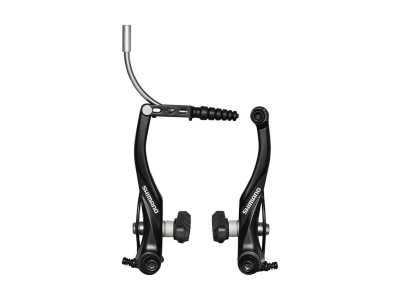
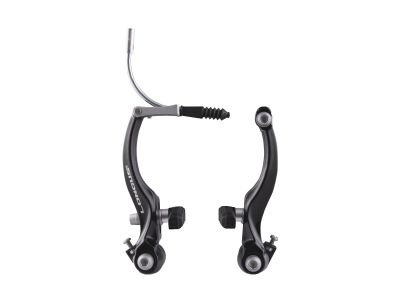
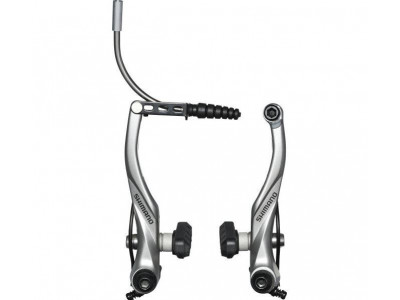
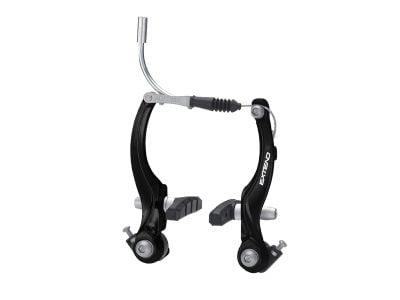
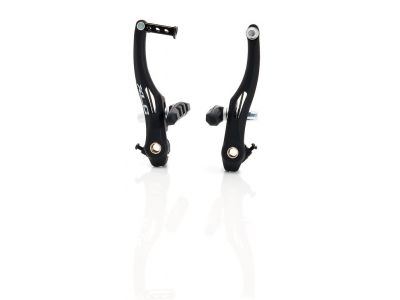
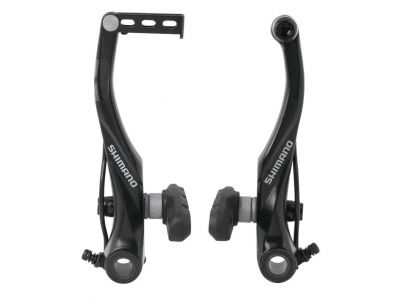
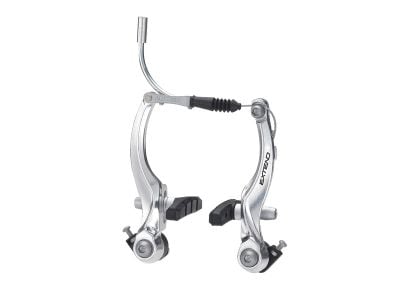
Rim brakes V-Brakes (Direct Pull)
- Characteristics: The most common type of rim brake on modern recreational MTBs. The calipers are long and thin and are activated by a direct pull of the cable from the brake lever.
- Advantages: They offer good braking performance, easy maintenance and are very affordable. They provide more power than older Cantilever brakes.
Cantilever brakes
- Characteristics: An older type that is still used today, mainly on cyclocross and some older MTB bikes. The brake arms are connected by a cable through a central pull cable.
- Benefits: They offer excellent clearance for wider tires and fenders, which is useful on older frames.
What are the main key advantages of rim brakes?
- Easy maintenance: Servicing and replacing brake pads is quick, easy, and can be done with minimal tools.
- Low weight and price: V-Brakes are some of the lightest and cheapest braking solutions available.
- Reliability: These are mechanical systems that are robust and undemanding.
Are rim brakes safe for off-road riding?
They are safe for recreational and moderately demanding off-road riding. V-Brakes provide sufficient power for controlled stopping. However, on long and steep descents or in wet/muddy conditions, their performance is significantly limited compared to disc brakes.
How often should brake pads be changed?
Replace the rubber pads if the worn surface is too thin, if they show grooves or cracks, or if braking performance drops significantly even when the lever is pressed hard. They wear out faster when frequently driving in wet and dusty conditions.
The brake lever is too soft, and I have to press it very hard. What can I do about it?
This indicates that the cable is stretched or worn. Use the adjusting screw on the brake lever (or caliper) to pre-tension the cable. If this does not help, the cable needs to be tightened in the caliper or replaced.
Do rim brakes wear out the rims?
Yes. Braking creates friction that gradually wears down the braking surface of the rim. The life of the rim is shortened. The rim should be replaced when the braking surface becomes dangerously thin (often indicated by a wear line on the rim).


 arrow_outward
