































































How to Run: Get to Know the Different Running Disciplines
What are the different types of running based on terrain and distance? Which running discipline is right for you?
Running is one of the fundamental athletic disciplines and one of the most natural and oldest forms of human movement. It can essentially be described as accelerated walking. However, running is much more complex than walking and engages almost all the muscles in the body.Running is a coordinated movement in which, at a certain point in each stride, none of the limbs are in contact with the ground. In races, the goal is either to cover a specific distance in the shortest possible time or to cover the greatest possible distance within a set time.
Road Running
Road running takes place on asphalt surfaces, such as roads, which are flat and hard. For beginners, it is a convenient way to start running, as you can simply head outside and begin with a few hundred meters.However, running on asphalt places greater stress on the feet due to the impact. It is therefore advisable to vary the running surface to help reduce the strain and, of course, choose appropriate footwear, such as road running shoes.
When it comes to specific racing distances, the most common disciplines include the 5 km, 10 km, half marathon, and marathon.


Marathon
A long-distance race covering exactly 42.195 km. Most of us probably know the story of the Greek soldier who is said to have established this distance by running from the city of Marathon to Athens to announce the defeat of the Persians. According to legend, the effort exhausted him so much that he collapsed and died.Half marathon
Exactly half the marathon distance, approximately 21.1 km. It is more popular among amateur runners because it is still a challenging distance but does not require the same level of training as a full marathon.Reaching these distances requires time and training. Beginners should gradually increase their mileage and set a realistic goal, such as 5 or 10 km. At first, even running 3 km may seem impossible, so a good method for beginners is the so-called “Indian run,” which alternates between running and walking.
In the beginning, technique, proper breathing, sufficient rest, and consistency are more important than distance. And, of course, patience.

 LukasHarant

 youtubetomasmartinak
Track Running
The running track at a stadium is a common training ground for athletes. Although running on a track can be a bit monotonous, it is ideal for developing speed and improving technique. It is also well suited to beginners: you do not have to worry about measuring distance or dealing with road traffic, and you can easily set your goal by the number of laps.Moreover, artificial track surfaces are softer, more consistent, and gentler on the joints than asphalt. Track competitions include sprint distances (100, 200, and 400 meters), middle distances (800, 1,500, 3,000, and 5,000 meters), as well as hurdle races and relays.
In bad weather or when suitable outdoor terrain is unavailable, running outdoors can be replaced by a treadmill, where distance, incline, and time can be easily adjusted.


Trail Running
Nature and mountains—that's what trail running is all about. Unlike the previous two types of running, trail running is characterised by uneven and varied surfaces, including forest trails, gravel, mountain paths, and rocky terrain. This type of running is anything but monotonous and requires specialised footwear, namely high-quality trail shoes.If you're new to running, start with less demanding terrain. Meadows, field paths, and forest roads with only gentle elevation changes are ideal. Running uphill requires a certain level of fitness, so it's best to build up your endurance gradually.
Distance is not the only factor in trail running; elevation gain also plays an important role. The main trail running disciplines include skyrunning, vertical runs, and ultramarathons.

Skyrun
A mountain run of more than 20 km with a minimum elevation gain of 1,200 m, where at least 5 % of the route has a gradient of 30 % or more. Often run at high altitudes. Its longer version, skyultra, covers more than 50 km and has an elevation gain of more than 3,000 m.Vertical run
Also known as a vertical kilometer. An uphill race in which runners gain 1,000 vertical meters over a short, steep course of around 5 km. The descent is not part of the race.Ultramarathon
A running discipline covering a distance longer than a classic marathon. Typical distances are 50 km, 100 km, or 100 miles (approximately 160 km). Ultramarathons also include multi-day and multi-stage races. In multi-day races, the goal is to cover a specific distance of more than 100 miles as quickly as possible.Multi-stage races are divided into several days (typically 3–4), with a certain distance covered each day, for a total distance of more than 100 km.
However, ultramarathons do not take place exclusively off-road; there are several formats in which runners cover these long distances on flat asphalt terrain. Relay running is also common in road ultramarathons.
Alternatively, the main factor may not be distance but time, with runners competing on a designated course for 24 or 48 hours.


Cross Country Running
It is characterized by open terrain and grassy or earthy surfaces, such as parks, meadows, and fields. Courses typically range from 3 to 12 km in length, and smaller obstacles are sometimes included.Orienteering
A special type of off-road running that does not have a marked course; runners navigate solely using a map and compass. The objective is to complete the route in the shortest possible time while passing through a specified number of checkpoints. It can be competed individually or in teams of two or three.Is it better to focus on road or trail running?
The health benefits of running can be found across all its disciplines. Each type of terrain has its own specific characteristics, advantages, and disadvantages. While trail running takes place in more scenic environments, offers greater variety, and engages more muscles, running on a smooth surface helps develop running dynamics, technique, and speed.If you want to run regularly and have racing ambitions, it is advisable to combine different disciplines. Variety helps prevent overloading the same parts of your body and keeps your training from becoming repetitive.
It is ideal to try different types of terrain and gradually gravitate toward your preferred discipline while finding the distance that suits you best. To get started, you do not need to invest in several types of footwear; all-round footwear will serve you well on both roads and easy trails.
Photo source: editorial archive
Similar articles
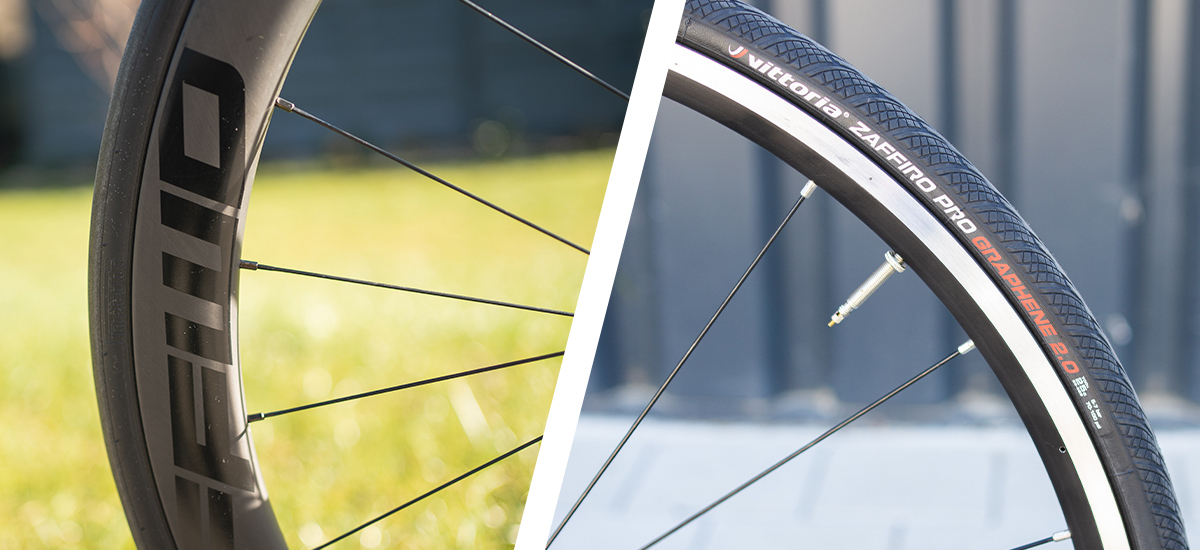
How do you navigate the vast selection of rims, wheels, and tyres? Will you choose aluminium or carbon, inner tubes, or even tubulars?

In recent years, I've been looking forward to the uphill climb much more, and going downhill feels like the hardest part of the hike. Do you feel the same?

In the mountains, even a minor injury can become much more serious—help may not arrive quickly. That’s why we must first be able to help ourselves.
Product selection

-17% adidas ULTRABOOST 5 shoes, lucid red/lucid red/matte gold
149 €
-17%
RRP 179 €


 arrow_outward
