

Clash of giants – Alps vs. Dolomites, or where to go first?
Riding through Italian passes captivates anyone who experiences it. But which is better, the Alps or the Dolomites?
Ever since I started watching the Giro d’Italia, it has been my lifelong dream to race along Italian roads like the pros. To experience all those breathtaking views, enjoy descents where switchbacks twist you like an earthworm, and taste the toughness of some climbs.You can't always get exactly what you want, but you can get a taste of Stelvio, Mortirolo, Gavia, Pordoi, Fedaia…
723 km and 21,000 meters of elevation gain
I managed to ride for 8 days in the Dolomites and Alps – 4 last year and 4 this year. So, the ride score is even.During this year's rides, I realised that although the Dolomites are essentially a sub-range of the Alps, in many ways they are diametrically different. If you're hesitating which way to go, I firmly believe this article will be at least somewhat helpful.
I'll also provide statistics multiple times for clarity – in this case, Alpine climbs will be marked in bold, and the Dolomites will be in regular text.

Distance
The first time we stayed in Arabba (630 km), the second time in Bormio (745 km). So, the distance is almost identical, give or take an hour and a half.What to add about the journey? It's always great when a group gets together and you can take turns driving. Otherwise, it's a crying shame of boredom, interspersed with numerous traffic restrictions, as Austrians always and gladly repair something.


In both cases, however, we managed our master plan: to arrive at our destination and still get some riding in that same day. Last year, it was Cima Coppi to Rifugio Auronzo right away; this year, a bit more relaxed to Torre di Fraele. So, the 3:30 AM alarm was worth it.
Length of climbs
If you've never ridden in big mountains, I'm convinced that the Dolomites are a good foundation. The climbs here are significantly shorter. For illustration purposes, I'll list the climbs we completed along with their length, elevation gain, and average gradient:- Passo del Foscagno from Bormio (24.2 km, 1111 m, 4.5%)
- Passo dello Stelvio from Bormio (21.3 km, 1560 m, 7.3%)
- Passo dello Stelvio from Santa Maria val Müstair (16.5 km, 1397 m, 8.4%)
- Passo di Gavia from Ponte di Legno (16.4 km, 1325 m, 8.1%)
- Passo di Cimabanche from Cortina d’Ampezzo (14.7 km, 344 m, 2.3%)
- Forcola di Livigno from Livigno (14.3 km, 514 m, 3.5%)
- Passo di Fedaia from Caprile (14.0 km, 1066 m, 7.5%)
- Passo del Mortirolo from Mazzo in Valtellina (12.1 km, 1313 m, 10.9%)
- Passo San Pellegrino from Moena (11.9 km, 752 m, 6.3%)
- Passo di Falzarego + Passo di Valparola from Cernadoi (11.9 km, 747 m, 6.3%)
- Passo di Sella from Canazei (11.0 km, 797 m, 7.2%)
- Bormio 2000 from Bormio (9.7 km, 742 m, 7.6%)
- Passo di Costalunga from Vigo di Fassa (9.2 km, 437 m, 4.7%)
- Passo Pordoi from Arabba (9.0 km, 634 m, 7.1%)
- Torri di Fraele from Torripiana (8.9 km, 624 m, 7.0%)
- Passo di Giau from Pocol (8.6 km, 687 m, 8.0%)
- Rifugio Auronzo from Col Sant’Angelo (7.4 km, 648 m, 8.1%)
- Passo di Campolongo from Corvara (6.2 km, 341 m, 5.5%)
- Passo Gardena from Plan de Gralba (5.8 km, 249 m, 5.4%)
- Passo Tre Croci from Lago Misurina (3.9 km, 153 m, 3.9%)
- Passo d’Eira from Ponte del Rez (2.9 km, 187 m, 6.4%)

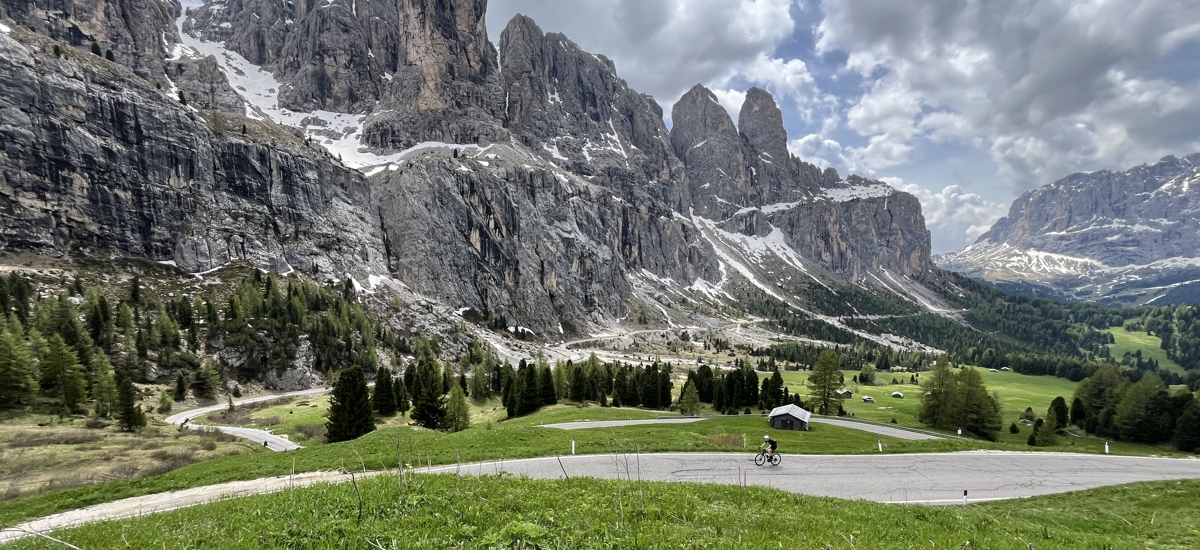
Majestic rock walls rise literally directly above you, and you feel like you're embraced by the mountains.
As you can see, Alpine climbs occupy the top spots. (Of course, also consider the elevation gain. You barely feel 344 m on Cimabanche). Not that climbs in the Dolomites aren't long – if you also consider the foothills, you often reach values over 30 km here. However, if you're starting from one point like us (i.e., not bikepacking), you simply have no reason to descend all the way down.
The Alps are treacherous in this regard – you always have to descend into the valley and complete the climbs in their full length. After riding in the Alps, I concluded that it's hard to prepare for this back home.

Longer climbs also mean another thing – less modularity. While in the Dolomites I could beautifully combine climbs so that each day was at least roughly balanced, in the Alps it was pointless to think about that. Just ride Stelvio from two sides, and you instantly have over 3000 meters of elevation gain. The same goes for the combination of Mortirolo and Gavia.
In practice, this means you rarely find a shortcut or can skip something. And so it happened that while I climbed Mortirolo in relative comfort, on Gavia I was switched off like a main circuit breaker, and I had no choice but to suffer through 5 km to the summit.
In this regard, I personally preferred the Dolomites – we did tackle several climbs, but they were shorter, allowing for quicker recovery.

Altitude a.k.a. oxygen debt
The Alps also win in another area, and that is the altitude of the passes. You can't go higher than Stelvio on asphalt in Italy (it should also be the 5th highest pass in Europe. But the source is Wikipedia 🙂). This time I won't list all 21 passes, but I'll make a top 10 ranking:- Passo dello Stelvio (2758 m a.s.l.)
- Passo di Gavia (2618 m a.s.l.)
- Passo Umbrail (2501 m a.s.l.)
- Rifugio Auronzo (2330 m a.s.l.)
- Passo del Bernina (2330 m a.s.l.)
- Forcola di Livigno (2315 m a.s.l.)
- Passo del Foscagno (2291 m a.s.l.)
- Passo di Sella (2240 m a.s.l.)
- Passo Pordoi (2239 m a.s.l.)
- Passo di Giau (2236 m a.s.l.)
As you can see, in the Alps you generally move several hundred meters higher. It's hard to say if you'll even experience significant oxygen debt. We mostly cruised in Z2-Z3, so everything was relatively easy to breathe through.
What you need to pay attention to is the weather. A descent from an altitude of over 2500 m a.s.l. will be felt a bit more by exposed knees…

Character of the environment
I warn you in advance that this section will be quite subjective. If I had to choose whether I liked the Alps or the Dolomites more, I would choose the Dolomites. Majestic rock walls rise literally directly above you there, and you usually feel embraced by the mountains. These jagged peaks are also more photogenic than Alpine summits.

The Alps are dominated more by wide, expansive, and grassy valleys. And that means only one thing – you'll more often encounter unpleasant wind here.
On Stelvio, I just had to let my friend get a little ahead of me, and if he hadn't waited, I wouldn't have been able to catch him in that headwind. So, it definitely pays to draft here. 🙂


At the same time, on Alpine climbs, you spend much less time riding through forests. So, in addition to several layers of clothing, you definitely shouldn't forget sunscreen. Skin the colour of a ripe bell pepper could remind you of a nice ride for a long time.
Paradise for motorcyclists and sports cars
Dreaming about the roads of the Giro d’Italia has one small catch – it will never be like the Giro d’Italia. No matter how beautiful Italian roads are, they are (almost) always (unfortunately) open to cars and motorcyclists. Perhaps nostalgic optimism has already set in for us, but after the Alps, we unanimously agreed that Italians weren't like this before.Last year, it happened that they even let us pass on descents, and from the entire trip, I remember only one 'rude' overtake.
This year, we experienced traffic jams, tight overtakes by trucks, honking, windshield washers… Well, different country, different customs. It's clear that the area around Stelvio is simply a much bigger mass attraction than the Dolomites (and the number of open stalls at the summit confirmed this to me).

Bottom line – any ragazzo who hasn't worn down their brake discs on their souped-up Fiat and burned out their clutch on Stelvio hasn't truly lived. I still maintain that the Dolomites are probably not yet as popular and don't suffer from such an onslaught.
But when I say A, I'll also say B. We had the evening road from Stelvio practically all to ourselves due to a closure. And I wish every lover of this discipline could experience a 20-kilometer descent down switchbacks without cars.
Road just wide enough for one car
I also noticed a subtle difference in the roads themselves. I'd leave the surface as is – it's almost everywhere above average (at least compared to what we ride on in our land of miracles). But on some Alpine passes, the width of the road literally struck me.I almost always planned our rides so that we went up the harder side and down the easier one. After all, tough guys need tough climbs. 🙂 A lower gradient on the way down also meant a safer descent.
In this category, I'll specifically highlight two passes: Mortirolo and Gavia. Mortirolo is narrow on both sides (because it's a third-class road), but I can't imagine how I would brake a 12-kilometer descent with such an average gradient.


However, the real 'chaos' awaited on Gavia. The road from Ponte di Legno is literally and figuratively wide enough for only one car in some sections, and even when riding uphill, it was problematic to avoid each other.
When I add the absent guardrails and the abyss below us… Any mistake on the descent here would be very cruelly punished.

In contrast, the descents in the Dolomites seemed controlled and safe to me. Of all the places we rode, the only narrower road was towards Rifugio Auronzo. Otherwise, you can 'let loose' to your heart's content downhill here – and most importantly, safely.

However, whether you choose the Alps or the Dolomites in Italy, you definitely won't escape goosebump-inducing emotions.
To see all those inscriptions on the road and imagine what it must be like when these climbs are ridden at pace and crowds of people are roaring all around… Add to that the beautiful nature, the majesty of high mountains, the 'fun factor' in the form of descents, and top-notch infrastructure, and you'll feel like moving here right away.
Or at least coming back again. 🙂
Photo source: editorial archive
Similar articles
Ever wondered just how slower a mountain bike is on asphalt climbs compared to a road bike? We tested and compared them, including the ride feel.
Why should you even start road cycling, and what's important when you're just beginning? You might find the answer in this article.
How does tire swapping actually work on a gravel bike? Can you ride it with smooth tires, just like a road bike?"

 arrow_outward
