



































































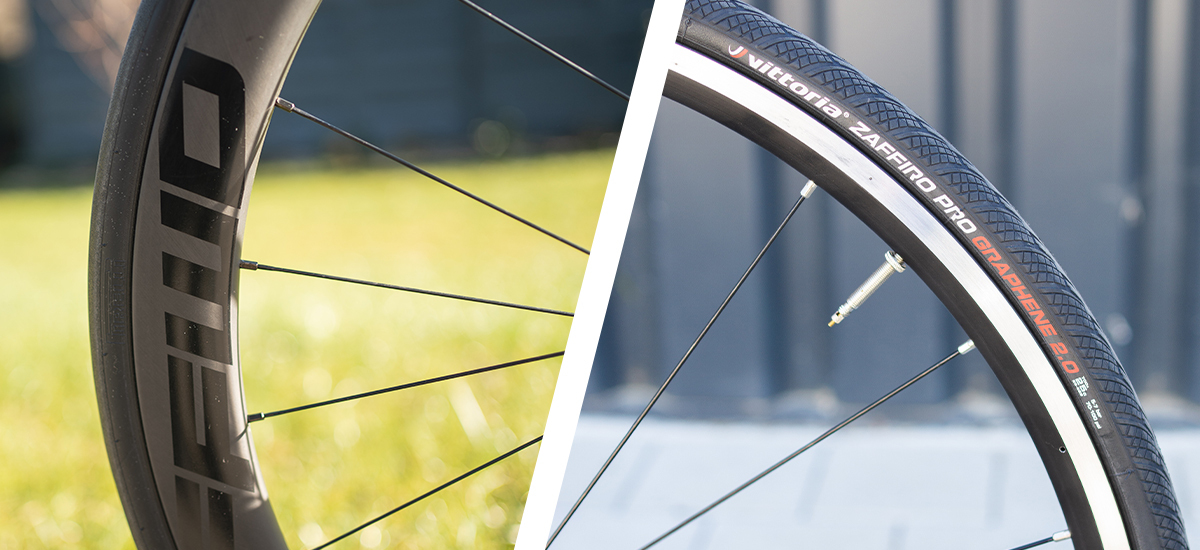
The Basics: How to Choose the Right Road Wheels and Tires
How do you navigate the vast selection of rims, wheels, and tires? Will you choose aluminium or carbon, inner tubes, or even tubulars?
The choice of wheel size for road cycling is quite straightforward: 28”, and you're all set. 🙂 However, it's also said that choosing the right wheels and tires can significantly influence your riding experience.As is often the case, the selection here is truly extensive. We can choose between various materials, rim heights, and hubs. We can decide whether to use classic inner tubes, switch to a tubeless setup, or go the “old-school” route and opt for tubular tires.
So, what setup is suitable for a specific discipline?
A Small Physics Window, or Is Weight Really That Important?
Many cyclists have certainly heard the magical term “rotational mass.” To break down how a bicycle moves, let's first disregard riding and focus on acceleration. It's different when the rotating and non-rotating parts of a bicycle accelerate.In the case of a non-rotating part, such as the frame, we're only talking about translational acceleration, whereas everything that spins, including the wheels, accelerates through a combination of translational and rotational acceleration.
Yes, based on physical formulas, rotational mass works against acceleration, approximately in a 1:2 ratio. The question is: how often do we accelerate when riding a road bike?
A time trial is an ideal example where wheel weight doesn't matter as much. The rider accelerates at the start and then simply maintains speed. In this scenario, a heavier solid rear wheel—or, more precisely, a disc wheel—can be beneficial, as higher wheel mass also means higher inertia. We don't even need to discuss aerodynamic efficiency.

Conversely, in races where acceleration and deceleration are frequent, such as criteriums and mountain stages, rotational mass plays a somewhat more significant role.
It's paradoxical, then, that while rotational mass is discussed so much, the rim profile, especially at the front, and its aerodynamic properties are equally important. When riding uphill, the rider's weight also matters. It's simple, many other significant factors influence the riding experience.
So, if you're not constantly braking and accelerating while riding your bike, lightweight wheels won't necessarily make a huge difference. At the same time, of course, that doesn't mean they aren't useful.
And the verdict? It's worth looking primarily for aerodynamically efficient rims, while also considering the stiffness of the setup, which is important for power transfer. Enough with the formulas—let's ride.
Aluminium as a Good Foundation
Similar to frames, aluminium is the most accessible and widespread material for wheel manufacturing. It's stiff, incredibly durable, and, last but not least, inexpensive. This is precisely why it remains so popular among hobby cyclists. In 99% of cases, aluminium wheels have a low rim profile.They're used by both recreational riders and amateur racers—the latter mostly use them as training wheels and switch to a more expensive carbon alternative for races. They're also a popular choice for winter riding.
A higher spoke count adds to their stiffness, but also to their weight.
When it comes to rim brakes, aluminium rims again have a slight advantage over carbon. Even in wet conditions and on longer descents, they maintain relatively consistent braking performance. It's also common to find carbon wheels with an aluminium braking surface.


Carbon Doesn't Just Provide Lightness
As we mentioned in the introduction, a light wheelset is far from a guaranteed win. Speaking for myself, I switched from 35 mm aluminium rims to 44 mm carbon rims. The final weight difference was negligible.What I primarily noticed was significantly greater overall stiffness and more efficient energy transfer. On climbs, I suddenly found myself riding out of the saddle much more often, where the bike's responsiveness is most noticeable. 🙂
If anyone is concerned about the fragility of the wheelset, it's true that carbon is at a disadvantage here. But again, I'll refer to my FFWD wheels, which have been through a lot with me (sometimes literally) and still show no signs of wear.

The second—and most crucial—factor is aerodynamics. Given the broader possibilities for shaping carbon fibers, wheel manufacturers can use the material much more effectively to create aerodynamically efficient rims.
My wheels, for example, bear the mysterious marketing designation LAW Tech. And this brings us to another important factor: rim height.
Deep rims are prettier. But are they better?
I won't pretend otherwise; I occasionally “drool” over wheels with deep rims (a.k.a. deep wheels), and I know I'm not the only one. 🙂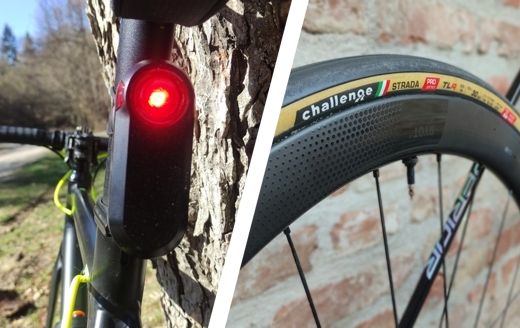
 LukasHarant
However, just like with frames, you need to choose the appropriate height based on what you plan to ride. We can generalize it as follows:
- the higher the rim profile, the higher the weight (more material on the rim)
- the higher the rim profile, the higher the aerodynamic efficiency (a time trial disc has the highest)
- the higher the rim profile, the greater the instability in crosswinds (lighter cyclists may start to feel discomfort even with 50 mm)
- the higher the rim profile, the lower the riding comfort (related to the aforementioned crosswinds, cornering, and acceleration)
...the external rim width affects aerodynamics, while the internal width, in conjunction with tires, influences comfort and rolling resistance...
Therefore, it's clear that if you primarily ride in the mountains, you should aim for wheels with a lower rim profile. Conversely, for predominantly flat riding, 50–60 mm rims are best suited to a hobby cyclist.
I personally opted for a “universal” setup, as I ride both. Furthermore, my 44 mm rims offer a relatively favourable weight, decent resistance to crosswinds, and, at the same time, somewhat higher aerodynamic efficiency. At least compared to my previous wheels.
Modern Trends in the Pro Peloton
Another magical dimension that has been frequently “discussed” lately is internal rim width. This is usually given in millimeters, followed by the letter “C.” Without it, the measurement refers to the external rim width.While this topic might be more popular in the MTB world, wider tires have also found their way into the WorldTour peloton, and truly “fat” tires are most often seen in races like Paris-Roubaix and the cobbled Flemish classics. We can probably thank aerodynamics for this again.
It was discovered some time ago that slightly wider rims are more aerodynamically efficient. Even more so when combined with the right tires.


The days of riding 21 mm “skinny” tires inflated to 6 bar are, thankfully, long gone. Physics speaks clearly, and although it sounds paradoxical, a slightly wider tire has lower rolling resistance.
Additionally, more air means greater comfort. That's why tires around 28 mm wide are most commonly chosen today.
In general, we can say that the external rim width affects aerodynamics, while the internal width, in conjunction with the tires, influences comfort and rolling resistance. The “105 rule” is interesting: it states that the external rim width should be at least 105% of the tire width.

Tubular vs. Inner Tubes vs. Tubeless
To start, I'll mention an important point—each type of tire requires a specific rim. Let's begin with the least common tire type: tubular tires. They are probably the least common for several reasons.The most significant one is likely that for an average hobby cyclist, especially a beginner, tubulars are “overkill.” Compared to regular clincher tires, you save some weight on the wheels due to their different rim construction, as well as on the tubular tire itself.
Due to their higher TPI (threads per inch, or weave density), tubular tires roll better and are more puncture-resistant. BUT. If you do get a flat, you can forget about patching an inner tube or using tire plugs.
However, I'll add in the same breath that, in the event of a puncture, tubulars are safe, as they won't instantly come off the rim. When it comes to maintenance, mounting a tubular tire is a bit more of a hassle than snapping a clincher tire into the grooves.
Given their properties, tubular tires are particularly popular among time trialists and can still be seen in professional cycling. There, a wheel with a flat can be changed in a flash.


For beginner cyclists, inner tubes will certainly be suitable. In terms of weight, they're more or less the same as tubulars (i.e., slightly to the disadvantage of inner tubes), but their biggest advantage is how easy they are to repair. You just need to carry a patch kit or a spare inner tube (I recommend both) and a small pump in your pocket. Repairs rarely take more than a few minutes.
In terms of maintenance, inner tubes are one of the least demanding options, and they also hold pressure for quite a long time. The disadvantage is their greater susceptibility to punctures or “pinch flats” against the rim at lower pressures. Personal experience. 🙂
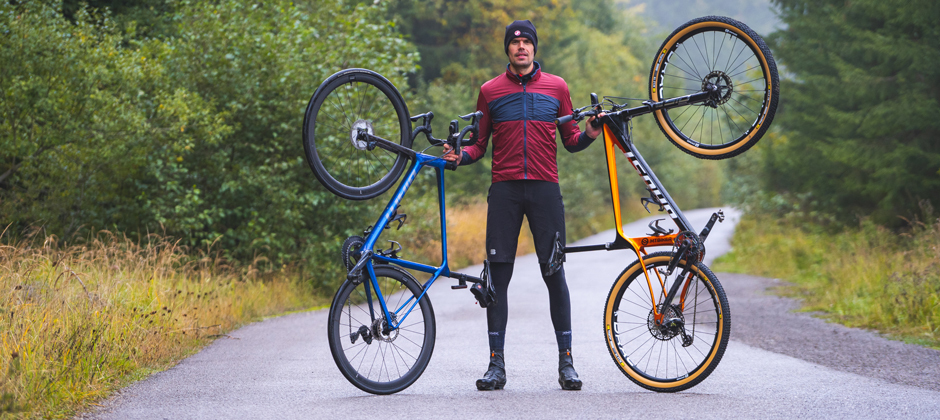
 Imroman
And finally, tubeless. The magical, marketing-hyped tubeless. 🙂 I recently succumbed to their charm myself and must say I don't regret it. Tubeless setups generally allow for lower pressures, which significantly improves comfort.
There's no need to fear punctures—unless you make a hole the size of a gear lever in your tire, sealant will usually take care of it. And what sealant can't handle, tire plugs can help with.
The disadvantages include relatively difficult installation and the need to regularly top up the sealant; otherwise, your tires might deflate within a few hours. Weight-weenies certainly won't like the slightly higher rotational mass caused by the sealant (of course, take that with a grain of salt 🙂).
However, if you're not a fan of Austrian-style asphalt (i.e., smooth as a baby's bottom) and occasionally like to “cut through” some dubious shortcut, tubeless setups will definitely come in handy.


A Bit About Hubs and Freehubs
I'll touch on this topic only briefly, as in my opinion, it's not that crucial for a hobby road cyclist. The equation is simple, however—the higher the quality of the hub, the higher the price. We can choose between cheaper but more difficult-to-adjust cup-and-cone bearings and the increasingly popular sealed cartridge bearings.Top models, in turn, can boast ceramic bearings, but from my perspective, this goes far beyond what a beginner needs to invest in.
In road cycling, the number of teeth in the freehub isn't as critical. A lower engagement angle is more appreciated by MTB cyclists when climbing over roots or rocks—in short, whenever they need to backpedal to avoid “catching” an obstacle and then start pedalling again. The higher the number of teeth in the system, the quicker the engagement.
What's more important is choosing wheels, or rather hubs, that fit your frame.
- For road frames, the issue is relatively simple—you just need to know whether you have quick releases or thru-axles.
- For quick releases, the classic dimensions are 5x100 mm for the front axle and 5x135 mm for the rear axle (or 9x100 mm and 10x135 mm).
- For thru-axles, it's 12x100 mm at the front and 12x142 mm at the rear. However, these systems can be combined using various adapters.
Which wheels to choose depends mainly on the environment you ride in. With tires, it's a bit more complicated, and often there's nothing left but to experiment. Hopefully, these tips will make the choice a little easier. 🙂
Photo source: editorial archive
Similar articles
While it may not be immediately obvious, road bikes come in several subcategories. So how do you choose the right one?
Everyone knows Tiagra, Ultegra, and Dura-Ace. But where do the names Shimano gives to its road groupsets come from?

What to focus on and how to choose a new road bike, so it meets your expectations to a T.



 arrow_outward
